


The 20th of January, one of the winter’s coldest days in the city of Minneapolis, one image taken by a local observer to the law led to a national debate about immigration law enforcement within the United States.
The image, now viral, depicts 5 year old Liam Conejo Ramos, dressed in the Spider-Man backpack and blue hat, being taken by federal police in a mask to an SUV that is parked on a dirt avenue located in Columbia Heights, Minnesota. After a short time, the picture was shared on X, Instagram, TikTok, Facebook, BlueSky, and Threads – triggering public outrage as well as legal scrutiny and, ultimately, a an order from a judge to release him.
The story of the image that swept the web and impacted the lawful record.
The Morning of the Incident in Columbia Heights
Ali Daniels, an office administrator from the Minneapolis metro area, recently completed her legal observer education. When she got an alert via text that warned her that ICE agents had been reportedly attacking schools stops for buses at Columbia Heights, she and another friend started patrolling the areas of residential homes to observe potential incidents.
In just a few minutes, they noticed an SUV parked in the middle of the road. Tactical vests and masks adorned by masked officers were standing nearby.
Daniels remembers seeing a tiny boy named Liam being led to a car. According to Daniels witnesses, the police were screaming instructions while people pleaded for Liam to allow him to travel in a school bus with the authorized staff of Columbia Heights Public Schools, in which he was a pre-kindergarten student.
Daniels states that her request was not granted.
“I decided to start taking pictures,” she later said. “It wasn’t part of the training–it was instinct.”
The girl sat at Liam’s level, and snapped the picture that would later be seen all over the world.
Why the Photo Went Viral
The significance of the image was in its specificity. The image of a child. A backpack. A winter hat. A street in the suburbs that can be found anyplace in America.
The image was shared on social media by users who reposted the photo with:
- Legal explanations
- Donation links
- Action calls
- The Liam family is demanding his release
The image quickly became a symbol for wider concerns regarding immigration policies implemented by Trump. Trump administration.
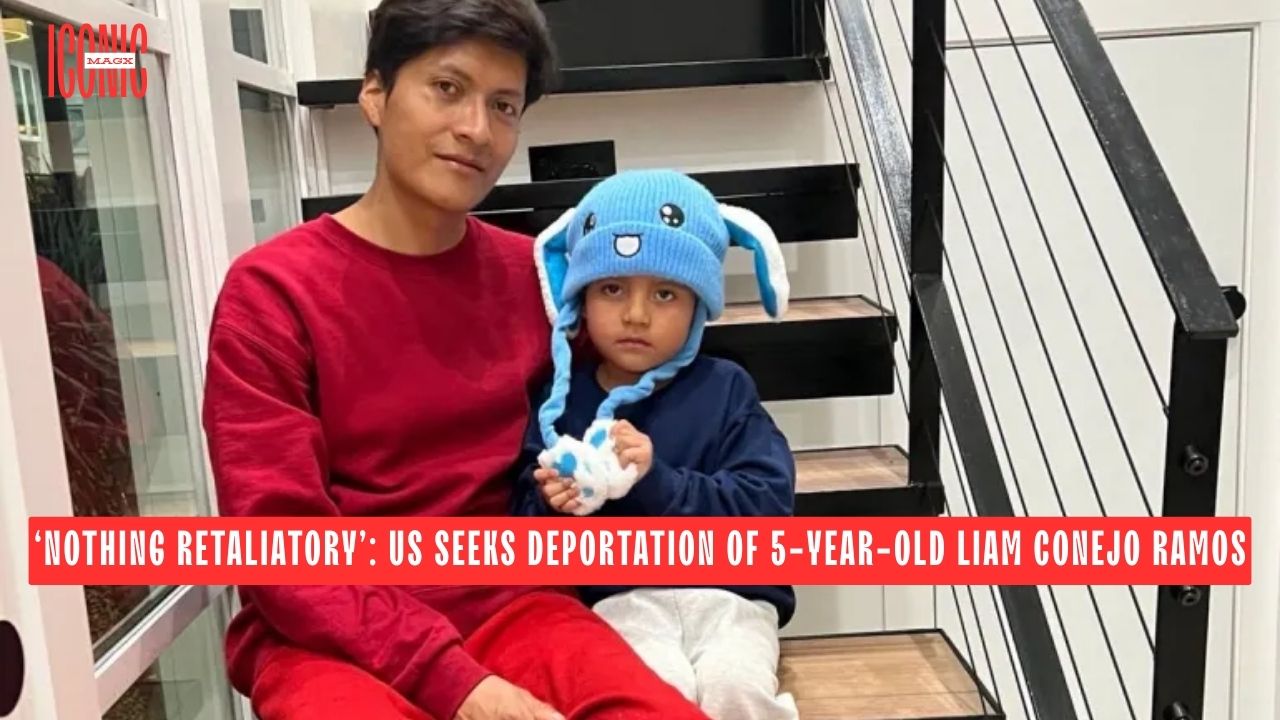
According to the district Liam was returning to school along with his father Adrian Alexander Conejo Arias at the time that immigration officers pulled them off the road. They were then taken to a center for detention in San Antonio, Texas.
It was reported that the Department of Homeland Security stated that ICE didn’t target the child specifically, rather it had an investigation to arrest the father. DHS claimed that the father. Conejo Arias was in his United States unlawfully in December 2024. The lawyer representing the family claimed that he was admitted in accordance with the current asylum rules.
A Federal Judge Responds
The 31st of January Fred Biery, U.S. District Judge of the Western District of Texas, granted the release of Liam as well as his father from the custody of immigration authorities.
In an unusual and symbolic act the judge Biery used the image of a viral photo in the written decision. In the caption Judge Biery cited two New Testament verses:
- “Let the little children come to me” (Matthew 19:14)
- “Jesus wept” (John 11:35)
The picture that was posted in a private page of Facebook was officially recorded in the legal record.
Political Response and Return to Minneapolis
After over a week of detention Liam as well as his father were let out and returned to Minneapolis.
U.S. Representative Joaquin Castro shared his journey through social media. A handwritten note, which he shared in public, he informed Liam that he’d “moved the world.”
“Liam has returned at home. He is wearing a hat and a backpack,”” Castro wrote. “Thank you to everyone who demanded freedom.”
The Role of Social Media in Modern Political Movements
This decision sparked debate over how online activism could translate into tangible change.
The historical parallels are:
- It was the Arab Spring, when social media amplify protest videos across the globe
- In 2020, the Black Lives Matter protests following George Floyd’s murder. George Floyd
But, over the last few years social media posts on politics have of late been accused of being “performative.” Black squares or hashtags and even popular infographics have caused a lot of skepticism.
A look at the Liam Conejo Ramos case complicates the account.
In this particular instance:
- The image sparked widespread attention.
- The incident prompted an investigation by the law enforcement authorities.
- It was a factor in a federal decision
- This led to their family’s exile
Digitally amplified public pressure and entangled with the judicial power.
Broader Immigration Context
Liam’s story isn’t isolated.
Based on an analysis of the immigration data conducted by the Deportation Data Project, thousands of children were admitted to immigration detention centers for families with immigrants between November 2025 and January 2025. Specific figures of the children who are currently in detention remain unclear.
Some critics argue that posting on a single platform can’t address the systemic problems. However, in Minnesota local groups, people use digital platforms for:
- Monitor the activity of ICE
- Teams that coordinate rapid response teams
- Use legal resources to share
- Protests can be organized.
- Offer templates to reach elected officials
In the present, smartphones are used as documentaries in the form of organizing hubs, documentation tools, as well as tools for public accountability.
The Photographer Speaks
When the photo circulated, certain online users doubted its authenticity, claiming the image could be created by AI. Daniels has publicly acknowledged her role as the photographer in order to prove that the photo’s source.
“It’s hard to be told you’re changing hearts and minds with one photo,” she told us, “while knowing that nothing is that simple.”
The instinctive choice to increase her cell phone changed the course of one family, and contributed to a wider shift in politics in Minnesota.
Final Analysis: When Images Shape Policy
The viral photo taken by Liam Conejo Ramos demonstrates how the digital media ecosystems are now interconnected with public law and policies. One image could:
- Humanize abstract policy debates
- Improve the speed of flow of information
- Mobilize nationwide attention
- In the courtroom, you can participate in proceedings
Although social media can’t resolve systemic issues on its own This case demonstrates that when the conditions are right it can impact results.
Liam is back in Minneapolis, complete with his backpack and his winter cap.
One photograph is now an important part of American legal time-line.




Leave a Comment